The loop
The four-day road through Quản Bạ, Yên Minh, Đồng Văn, and Mèo Vạc.
The high road
QL4C leaves the town toward Quản Bạ. Heaven’s Gate is the pass lookout over the winding road, mist, and valleys. Cafe Cổng Trời is the veranda coffee on that pass. Tam Sơn, now in xã Quản Bạ, is lunch: northern fare at the stalls, and coffee. The overnight that day is Yên Minh, not Tam Sơn. Pine forest stands beside QL4C. Dốc Chín Khoanh, between Yên Minh and Sà Phìn, is the curved road into the valley. Stop off the curve.
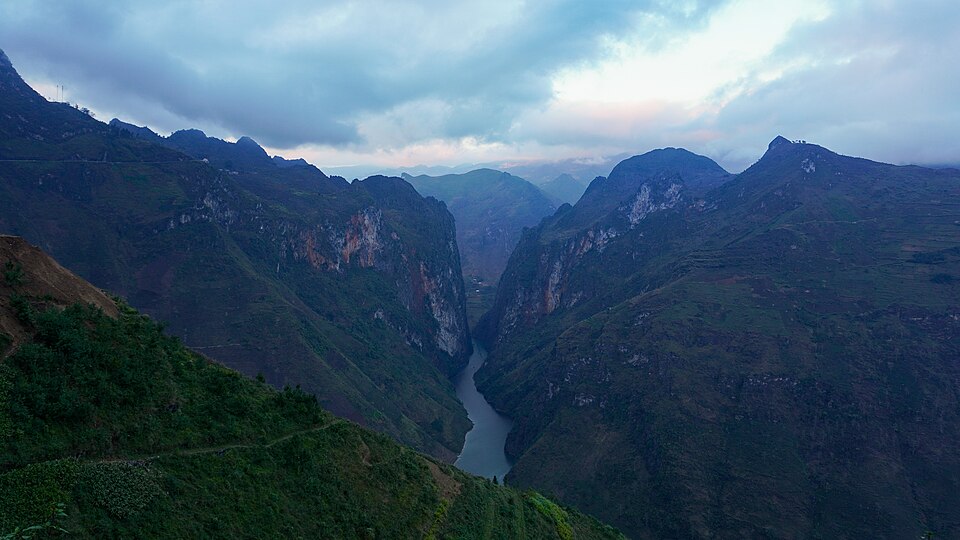
Mã Pì Lèng is the rim between Đồng Văn and Mèo Vạc, in Mèo Vạc. The canyon below is Tu Sản. Side road 193A drops closer to the river. A boat or a kayak is named for June, when the river is full.
The sky path above the Nho Quế is a steep walk of 500 metres, about two hours, through Flower Hmong villages. The return on QL34 sleeps in Bảo Lâm and eats at the stalls in Bắc Mê. That valley is not Mã Pì Lèng.
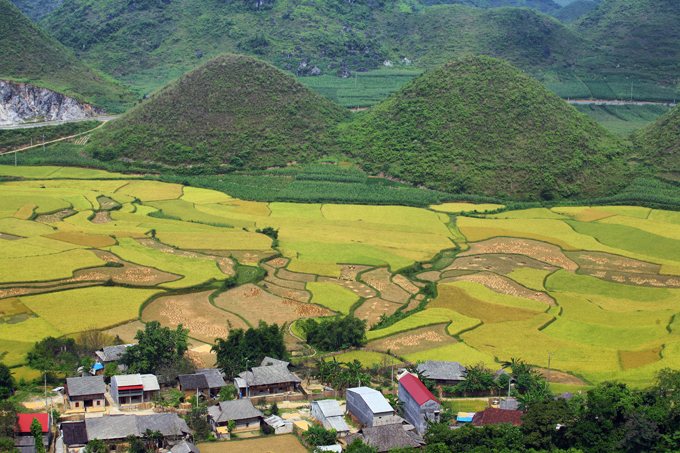
Quan Ba and the terraces
Núi đôi Quản Bạ are the two rounded hills above the terraces. The caption on the photograph is Núi đôi Quảng Bạ. The hills, the terraces, and the karst in cloud are the picture of this loop. Xã Quản Bạ joins thị trấn Tam Sơn, xã Quyết Tiến, and xã Quản Bạ. Xã Cán Tỷ joins Bát Đại Sơn and Cán Tỷ.
Hoàng Su Phì is a different valley. In June the terraces are flooded, farmed by Dao, Nùng, and La Chí. September golden rice is another window.
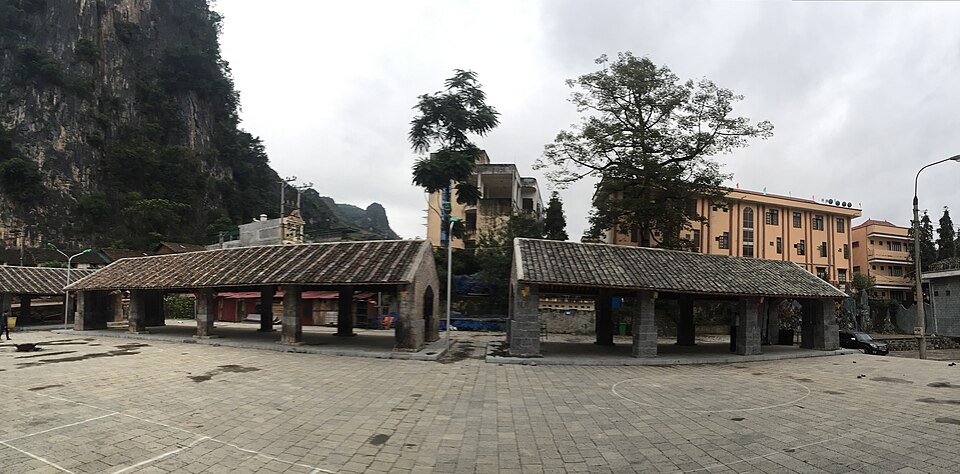
Dong Van
Đồng Văn is the stone town. About 40 houses from 1890, a market and houses together. Walk the old quarter. Use the market at night or early morning. Sunday is the market day in Đồng Văn and Mèo Vạc. Arrive before sunset. The pass and the old quarter are not the same hour.
Đồn Cao is a 20-minute hike up from Đồng Văn for the view. Go in daylight. Mèo Vạc, 24 km over the pass, is lunch and, on some routes, a night. Sunday is its market too. Xã Đồng Văn and xã Mèo Vạc are the 2025 communes. Older pages still say the towns.
The Hmong palace
Dinh thự họ Vương, also called Dinh vua Mèo, stands in thôn Sà Phìn, xã Sà Phìn. The building is green stone, po mu wood, and terracotta, carved with dragon, phoenix, and bat. Vương Chính Đức’s house has three courtyards and a stone bath. The frame is wood. The style is given as Chinese, and also as Chinese, French, and Hmong.
It is a national architectural relic from 1993. The building cost named for it is about 150,000 Indochinese silver đồng. Go in daylight.
Sunday markets
Sunday is the market in Đồng Văn and Mèo Vạc. Khau Vai love market is in the spring, with the March flowers, on the Mèo Vạc side. The buckwheat festival is typically mid-to-late November in Đồng Văn district, with cultural displays, crafts, buckwheat food, a road race, and kayak and paddle-board racing on the Nho Quế. The Tày fish festival at xã Mậu Duệ is named for 2026.